Ancient Chinese “Unicorn” Revealed To Be Dancing Horse With Tassel On Head
A n archeological mystery 1,300 years in the making – why ancient Chinese artists would sculpt a single “unicorn” in a sea of horses – has finally been solved. The answer: they didn’t. But a new study, published in the journal Heritage Science , has discovered what really happened. The first half of the eighth century was a golden age in Chinese history. It was the height of the Tang Dynasty; the Emperor, Xuanzong, had become known for improvements and reformations in everything from the bureaucracy that ran the Empire to the transportation systems that reopened China to the world and spread the nation’s influence far and wide. He was also known for his horses. With the uptick in trade and military campaigns – plus the Emperor’s personal fondness for the animals – horses became a symbol of prosperity, associated with dragons , and ubiquitous throughout the country. Xuanzong himself was said to have a stable of more than 40,000, some of whom were specially trained to “dance” in time to the beat of a drum – he reportedly had 400 of them perform a dance to the “Song of the Upturned Cup” for one birthday celebration, for example, which we’re betting is more than you ever got. “During the dramatic finale, one horse would bend its knees and clench a cup in its mouth and offer wine to the ruler to wish him longevity,” explained Hou-mei Sung, Cincinnati Art Museum’s East Asian art curator, in a statement . “This became a ritual.” And it’s one of these horses that was memorialized in a little sculpture that’s been causing so much fuss. Measuring just 66 centimeters (26 inches) tall, the terracotta statue shows the animal standing, mid-prance, with one hoof lifted from the ground. It wears a blanket and a…
A n archeological mystery 1,300 years in the making – why ancient Chinese artists would sculpt a single “unicorn” in a sea of horses – has finally been solved. The answer: they didn’t. But a new study, published in the journal Heritage Science , has discovered what really happened.
The first half of the eighth century was a golden age in Chinese history. It was the height of the Tang Dynasty; the Emperor, Xuanzong, had become known for improvements and reformations in everything from the bureaucracy that ran the Empire to the transportation systems that reopened China to the world and spread the nation’s influence far and wide.
He was also known for his horses.
With the uptick in trade and military campaigns – plus the Emperor’s personal fondness for the animals – horses became a symbol of prosperity, associated with dragons , and ubiquitous throughout the country. Xuanzong himself was said to have a stable of more than 40,000, some of whom were specially trained to “dance” in time to the beat of a drum – he reportedly had 400 of them perform a dance to the “Song of the Upturned Cup” for one birthday celebration, for example, which we’re betting is more than you ever got.
“During the dramatic finale, one horse would bend its knees and clench a cup in its mouth and offer wine to the ruler to wish him longevity,” explained Hou-mei Sung, Cincinnati Art Museum’s East Asian art curator, in a statement . “This became a ritual.”
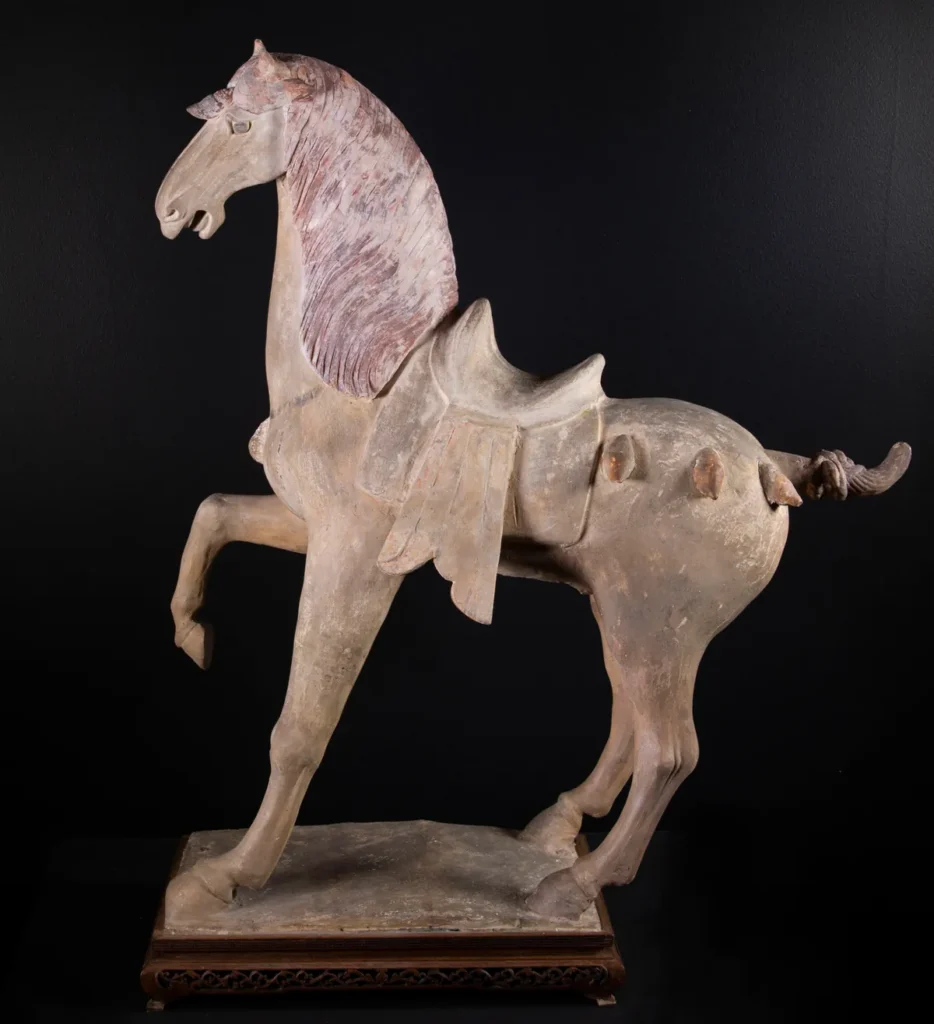
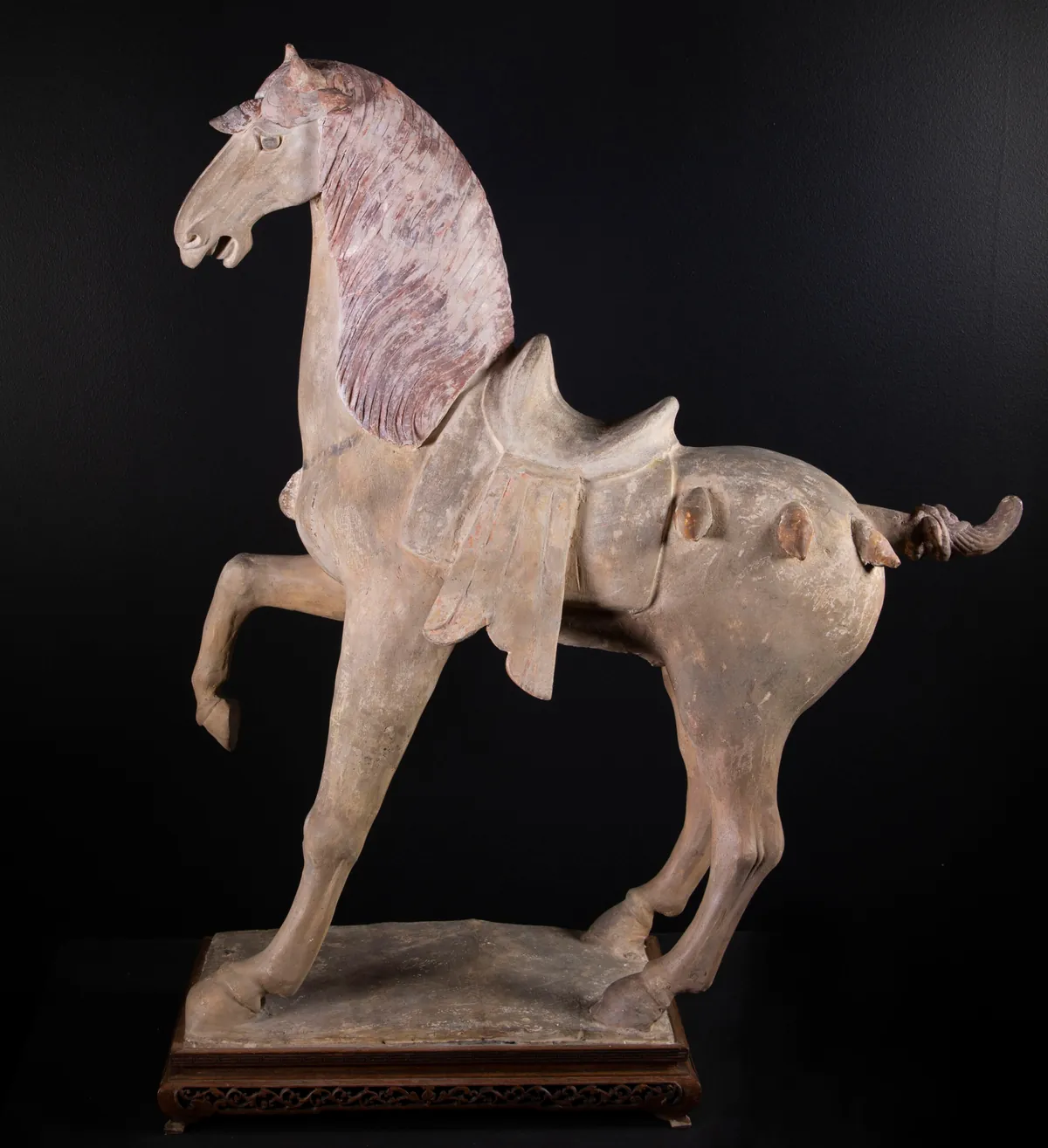
And it’s one of these horses that was memorialized in a little sculpture that’s been causing so much fuss. Measuring just 66 centimeters (26 inches) tall, the terracotta statue shows the animal standing, mid-prance, with one hoof lifted from the ground. It wears a blanket and a flowing silken material over its back, with 10 conical tassels hung decoratively around its body.
But that’s where the problems came in. When the horse was originally crafted all those centuries ago, those tassels didn’t look how they do now – at some point in the past 1,300 years, somebody switched up their placement. And there’s one in particular that gave the game away.
“The peculiarity of the Tang Dynasty dancing horse of the Cincinnati Art Museum is the presence of an odd placement of the tassel on the forehead of the horse,” explains the paper. “The placement is unusual and is paired with an odd bare area on the body of the horse above the standing leg where, consistent with the tassel pattern around the body, it appears that a tassel is missing.”
To a specialist like Sung, it really sticks out. “I believed it was a mistake,” she said. “These pieces are so old. They often go through many repairs.”
And so the museum reached out to Pietro Strobbia, an assistant professor of chemistry at the University of Cincinnati College of Arts and Sciences, to help figure out what the rogue tassel was doing on the horse’s forehead – and whether it was original at all.
“Many museums have a conservator, but not necessarily scientific facilities needed to do this kind of examination,” said Strobbia. “The forehead tassel looks original, but the museum asked us to determine what materials it was made from.”
Along with collaborators such as the Institute of Heritage Science in Italy, Strobbia and his team took 11 tiny samples from the sculpture for analysis. A battery of molecular, chemical, and mineralogical tests of the horse, using cutting-edge techniques like X-ray powder diffraction, ionic chromatography, and Raman spectroscopy, revealed that the head tassel wasn’t just misplaced – it wasn’t original at all.
“The odd tassel on the head and other two tassels on the body are not original but replaced or added in subsequent time,” notes the paper.
“Once the tassel was removed there was no evidence on the head, such as scoring, to indicate that there had ever been a clay attachment here,” the authors explain. “Plaster… has been used at the top of the tassel to create a surface that allows it to conform to the forehead for attachment. Beneath the plaster a chalky grey material can be seen which has a completely different curvature that does not match the forehead of the horse, further supporting that this tassel was never originally positioned on the forehead.”
But while the forehead tassel may have stuck out more than the others, it wasn’t the only recent addition to the horse. In fact, three tassels in total had been repaired over the years, and X-rays revealed breaks throughout the statue, from the horse’s mane all the way down to the platform it stands on. At this point, the researchers discovered, it’s actually being held together in a large part by pieces of dowel.
“It was restored at least twice in its lifetime,” said Kelly Rectenwald, co-author of the paper and associate objects conservator at the Cincinnati Art Museum. “Finding anything new about an artwork is really interesting.”
With the mystery of the horse with the forehead tassel solved, the case stands as a testament to how science can help inform art – and Strobbia hopes to be able to help other museums with their collections in the future.
May you like

“We don't have that kind of scientific equipment here, so partnering with UC has been a great resource,” said Rectenwald.
“The making of the sculpture is beautiful,” she added. “These horses are renowned.”