“A BIT OF A SH:0CK TO THE SYSTEM”: The Heartbreaking Family Story Behind Andy Lee’s Wedding — And the Miracle His Family Never Expected in His Mum’s Fight for Life – joy.blog360net.com
As Andy Lee celebrates marrying Rebecca Harding after 12 years together, there is a deeply personal chapter of his life that makes this milestone even more meaningful. When Andy was just 15, his mother, Margaret, was given only two weeks to live. She survived against the odds, but the illness left her unable to walk, speak or recognise her own children. Nearly three decades later, she remains an important part of his life — a reminder of just how close his family once came to losing someone they loved. The Family Heartbreak That Almost Changed Everything Andy Lee is celebrating one of the happiest moments of his life after marrying his longtime partner, Rebecca Harding, in New York City. The comedian and television personality has spent more than a decade building a relationship with Rebecca, with the couple finally exchanging vows this week in front of family and close friends. But behind the celebrations lies a family story that began long before Andy became one of Australia’s most recognisable entertainers — a story that nearly ended in tragedy when he was still a teenager. In 1996, when Andy was just 15, his mother, Margaret Lee, suddenly became seriously unwell. She was diagnosed with cerebral vasculitis, a rare inflammatory condition affecting blood vessels in the brain. The illness progressed rapidly, affecting her ability to walk, speak and recognise the people closest to her. Doctors gave Margaret just two weeks to live because they did not yet fully understand what was happening. Speaking to Jamila Rizvi on The Briefing podcast in 2021, Andy recalled how quickly his family’s world had changed. “I really thought Mum was going to die,” he admitted. For a teenage boy, the prospect of losing his mother was almost impossible to comprehend. Yet the days that followed brought…
As Andy Lee celebrates marrying Rebecca Harding after 12 years together, there is a deeply personal chapter of his life that makes this milestone even more meaningful. When Andy was just 15, his mother, Margaret, was given only two weeks to live. She survived against the odds, but the illness left her unable to walk, speak or recognise her own children. Nearly three decades later, she remains an important part of his life — a reminder of just how close his family once came to losing someone they loved.
The Family Heartbreak That Almost Changed Everything
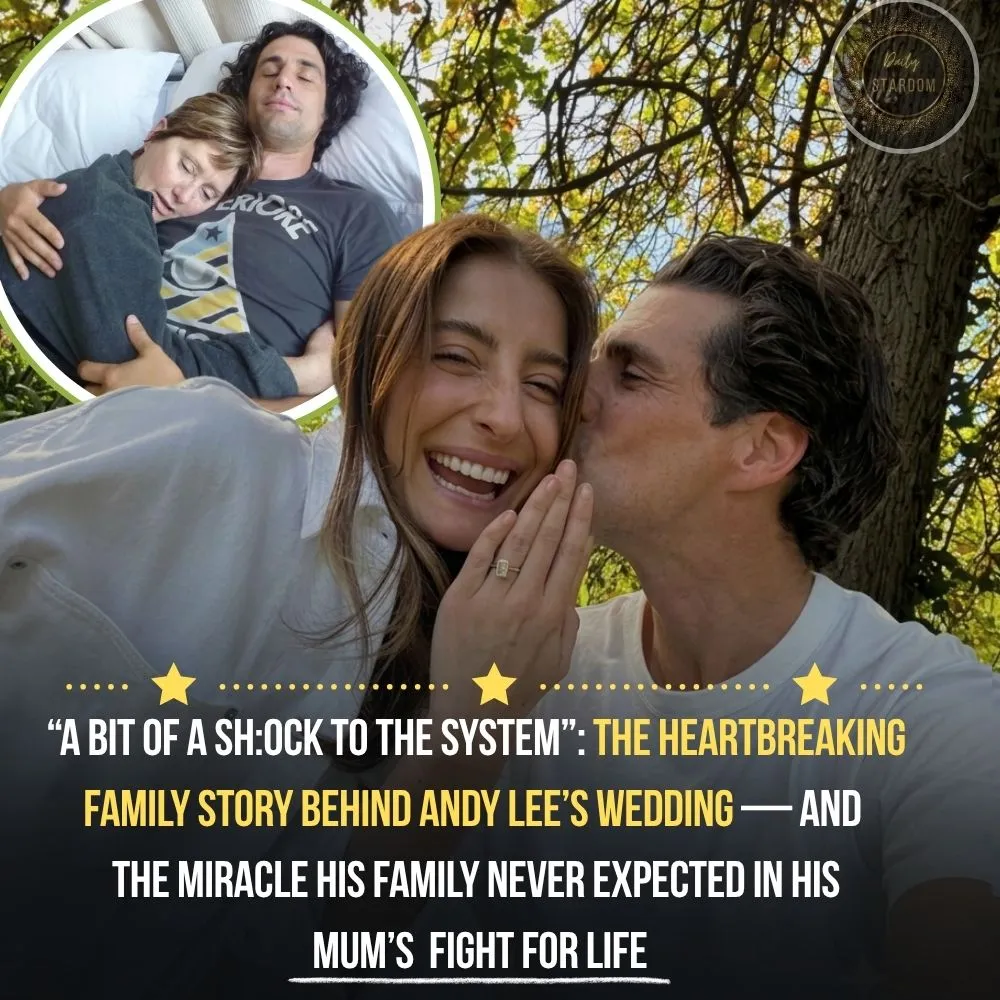
Andy Lee is celebrating one of the happiest moments of his life after marrying his longtime partner, Rebecca Harding, in New York City.
The comedian and television personality has spent more than a decade building a relationship with Rebecca, with the couple finally exchanging vows this week in front of family and close friends.
But behind the celebrations lies a family story that began long before Andy became one of Australia’s most recognisable entertainers — a story that nearly ended in tragedy when he was still a teenager.
In 1996, when Andy was just 15, his mother, Margaret Lee, suddenly became seriously unwell. She was diagnosed with cerebral vasculitis, a rare inflammatory condition affecting blood vessels in the brain.
The illness progressed rapidly, affecting her ability to walk, speak and recognise the people closest to her.
Doctors gave Margaret just two weeks to live because they did not yet fully understand what was happening.
Speaking to Jamila Rizvi on The Briefing podcast in 2021, Andy recalled how quickly his family’s world had changed.
“I really thought Mum was going to die,” he admitted.
For a teenage boy, the prospect of losing his mother was almost impossible to comprehend. Yet the days that followed brought another kind of heartbreak: Margaret survived, but the person who returned to the family was struggling with abilities and memories that had once come naturally.
‘I’m Andy. I Play the Trumpet. I Like Hockey.’
One of the most painful consequences of Margaret’s illness was the effect it had on her memory.
Andy recalled that his mother had forgotten how to walk and talk, and could no longer remember who her children were.
For a teenager accustomed to the everyday reassurance of having his mother around, the change was devastating.
When he visited her after school, he often had to introduce himself all over again.
“It felt a bit like Groundhog Day,” he explained, describing how he would tell her who he was and share small details about his life.
“I’m Andy. I play the trumpet. I like hockey.”
The details were ordinary, almost insignificant in any other circumstance. But at the time, they represented an attempt to rebuild a connection with the woman who had always known him.
Imagine being 15 years old and having to remind your own mother of your name, your interests and the person you are — not because she no longer cared, but because a serious illness had affected her ability to remember.
It was a deeply unsettling experience for the entire family.
And even when Margaret began to recover, the emotional effects of what had happened did not simply disappear.
The Recovery That Changed Their Family Forever
Margaret’s survival was extraordinary in Andy’s eyes. He later suggested that she may have been the first person in Australia to survive her particular condition, although he acknowledged that he could not be certain.
Her recovery gave the family something they had nearly lost: more time together.
But returning home after months in hospital brought its own challenges.
During a later interview on ABC’s The Assembly , Andy reflected on how much had changed while his mother was unwell.
Before her illness, Margaret had been deeply involved in her children’s everyday lives. She helped prepare Andy’s lunch before school and looked after the small routines that made a family feel secure.
During her long hospital stay, however, Andy and his younger sister, Alex, had learned to become more independent.
When Margaret eventually returned home, she had to adjust to a family dynamic that was no longer quite the same.
Andy admitted that, at first, he struggled to understand her reaction. He had spent months fearing for her life, only to find that their relationship did not immediately return to the way it had been before.
He later came to understand that Margaret was also facing an enormous adjustment after an experience that had fundamentally changed her life.
It was a reminder that surviving a serious illness does not mean every part of life returns to normal overnight. Recovery can involve rebuilding not only physical abilities, but also relationships, routines and a sense of belonging.
For Andy and Alex, the experience changed how they viewed their family and the time they had together.
The Unexpected Silver Lining Andy Never Forgot
Despite the fear and uncertainty of those early days, Andy has said that the experience ultimately brought him and his sister closer.
Before Margaret became seriously ill, their family had already been close.
But the crisis gave them a new appreciation for one another and the importance of maintaining those connections.
Andy later explained that he and Alex now see each other several times a week and speak every day.
He described that closeness as one positive thing to emerge from an experience that had once seemed overwhelmingly frightening.
It is a striking reflection from someone who had been told that his mother might not survive.
Rather than pretending the experience had been easy, Andy acknowledged the fear, the confusion and the lasting effect it had on the family. But he also recognised that they had come away with a stronger commitment to spending time together.
The lesson was not that the illness had somehow been worthwhile. It was that, having faced the possibility of losing their mother, they had become more conscious of the importance of the time they still had.
That perspective appears to have remained with Andy throughout his adult life.
From a Teenage Boy’s Fear to a Son’s Gratitude
Andy has spoken about his mother’s illness more than once over the years, offering glimpses into an experience that shaped him long before his comedy career took off.
In his conversations with ABC’s The Assembly and other interviewers, he has reflected on the emotional complexity of watching a parent recover from a condition that had initially seemed fatal.
There was relief that Margaret had survived, but also sadness about what she had endured and the changes the family had to navigate afterwards.
His recollections reveal a vulnerable side to the comedian that audiences do not always see.
On television and radio, Andy is known for his quick humour, light-hearted personality and long-running partnership with Hamish Blake.
Yet his story about Margaret offers a different perspective: that of a teenage son who had to confront the possibility of losing his mother and later learn to understand her recovery.
The experience also appears to have reinforced the value he places on his family relationships.
Rather than allowing the years to distance them, Andy and Alex have continued to make time for one another — something he has described as one of the lasting positives to emerge from their family’s ordeal.
A Mother Who Is Still Part of His Life Today
Nearly 30 years after Margaret’s diagnosis, Andy has continued to share occasional glimpses of family life with his mother.
In April 2026, he posted a video from the family’s Easter celebrations showing Margaret taking part in a game of cornhole alongside other relatives.
“Mum was clutch in Corn Hole,” he captioned the post, celebrating her contribution to the family fun.
It was a simple, cheerful moment — a long way from the frightening days when doctors had warned that she might have only weeks to live.
The video offered a glimpse of Margaret enjoying time with the people closest to her, and it illustrated just how much life had unfolded since the family’s darkest period.
For those who remember Andy’s account of having to reintroduce himself to his mother after school, seeing her participating in family celebrations carries a particular emotional resonance.
The moment does not erase the challenges she has faced, nor does it tell the full story of her health. But it offers a reminder that the family has continued to share ordinary, joyful experiences after a period when they feared those moments might never come again.
Andy’s Wedding: A New Chapter After Years of Waiting
Andy’s wedding to Rebecca marks another major milestone for a couple whose relationship began in 2014.
They first met at a Melbourne café where Rebecca was working as a waitress.
Andy left his email address on a napkin, and Rebecca eventually contacted him, leading to their first date the following day.
The pair went public with their relationship in 2015, briefly separated in 2016 and later reconciled. Andy proposed in 2024, after a decade together.
Their New York wedding this week brought that long journey to a new chapter.
The ceremony was attended by close friends and family, including Andy’s longtime comedy partner Hamish Blake, Hamish’s wife Zoë Foster Blake, and several of Andy’s closest friends.
It has not been confirmed whether Margaret attended the wedding in New York, so her presence at the ceremony should not be assumed. But her story remains an important part of the wider family milestone, given how dramatically her illness once changed their lives.
For Andy, the wedding represents the beginning of married life with Rebecca, the person with whom he has spent more than a decade building a future.
For his family, it is another significant moment in a life that has included profound uncertainty as well as great happiness.
May you like


A Story About the Moments We Almost Lose
Andy Lee’s mother’s illness is a reminder that life’s most important moments are not always the ones that attract headlines.
Sometimes they are the small, everyday things: a parent remembering their child’s name, a family sharing a meal, a game played together during a holiday, or the opportunity to celebrate another milestone with people who have been part of your life for decades.
When Margaret was diagnosed in 1996, Andy was only 15. The possibility of losing her arrived before he had even reached adulthood, leaving him to confront a fear that no teenager should have to face.
Her survival gave their family more time, although the road back was neither simple nor immediate.
Today, as Andy begins married life with Rebecca, that earlier chapter offers a different perspective on the significance of family milestones.
It is not known whether Margaret was present in New York, but the journey she and her children have shared helps explain why each new family memory can be so precious.
The wedding is a joyful event in its own right. Yet the story behind it carries a quieter emotional weight — one rooted in the knowledge that there was a time when the future looked very different.
Nearly 30 years ago, Andy feared he was about to lose his mother. Today, she remains part of his life as he begins a new chapter of his own. It is a reminder that sometimes the most moving celebrations are not just about what lies ahead, but about the people we once feared we might never have the chance to celebrate with again.