How Kenny Rogers Put His Mother on the Road at Last
A dream deferred in Houston Long before Kenny Rogers became one of the most recognizable voices in American popular music, his mother Lucille Lois Hester Rogers lived a life defined by work, duty, and narrow geography. In Houston, Texas, she raised eight children in San Felipe Courts, a federal housing project, stretching every dollar and every hour. Her world was not built around leisure or escape. It was built around survival. While her husband, Edward Floyd Rogers, struggled with alcohol, Lucille kept the household going through a patchwork of exhausting jobs. She worked night shifts as a nursing assistant, waited tables, and took in laundry and ironing at home. The rhythm of her days was relentless: feed ten people, manage the house, go to work, come back, and start again. Travel, for a woman in that position, was not a hobby or even a realistic plan. It was a private wish postponed by necessity. The mother behind the music In family stories about Kenny Rogers, Lucille often appears not as a grand stage mother but as something more durable: the person who kept hope alive in practical ways. Even with almost nothing to spare, she found bits of change to support her son’s early love of music. That detail matters because it captures the scale of her sacrifice. This was not generosity from abundance. It was belief carved out of scarcity. For children raised in hard circumstances, parental support can arrive in small denominations and still alter a life. Lucille’s contribution was not glamorous. It was the kind of backing that happens quietly, in kitchens and after shifts, when a parent decides that a child’s interest is worth protecting. By the time Rogers reached the top of the entertainment world, he had not forgotten who had made room for his…

A dream deferred in Houston
Long before Kenny Rogers became one of the most recognizable voices in American popular music, his mother Lucille Lois Hester Rogers lived a life defined by work, duty, and narrow geography. In Houston, Texas, she raised eight children in San Felipe Courts, a federal housing project, stretching every dollar and every hour. Her world was not built around leisure or escape. It was built around survival.
While her husband, Edward Floyd Rogers, struggled with alcohol, Lucille kept the household going through a patchwork of exhausting jobs. She worked night shifts as a nursing assistant, waited tables, and took in laundry and ironing at home. The rhythm of her days was relentless: feed ten people, manage the house, go to work, come back, and start again. Travel, for a woman in that position, was not a hobby or even a realistic plan. It was a private wish postponed by necessity.
The mother behind the music
In family stories about Kenny Rogers, Lucille often appears not as a grand stage mother but as something more durable: the person who kept hope alive in practical ways. Even with almost nothing to spare, she found bits of change to support her son’s early love of music. That detail matters because it captures the scale of her sacrifice. This was not generosity from abundance. It was belief carved out of scarcity.
For children raised in hard circumstances, parental support can arrive in small denominations and still alter a life. Lucille’s contribution was not glamorous. It was the kind of backing that happens quietly, in kitchens and after shifts, when a parent decides that a child’s interest is worth protecting. By the time Rogers reached the top of the entertainment world, he had not forgotten who had made room for his ambitions when there was barely room for anything else.
She had spent years putting her own plans aside while helping make his possible.
A woman who wanted to see beyond the neighborhood
Lucille wanted to travel. That desire had lived with her for years, even as her life remained tightly bounded by work routes and family obligations. The route between jobs and home became, in effect, the map of her world. For many Americans of her generation and class, especially women carrying the full weight of a household, the idea of seeing the country could feel both vivid and impossibly distant.
Her husband’s habits made that distance even greater. He disliked leaving the house and refused to take trips, a preference that effectively closed off one of the most ordinary ways families experience the wider world together. So Lucille’s wish remained just that—a wish. She kept moving, kept earning, kept caring for others, while the country beyond Houston existed mostly as imagination.
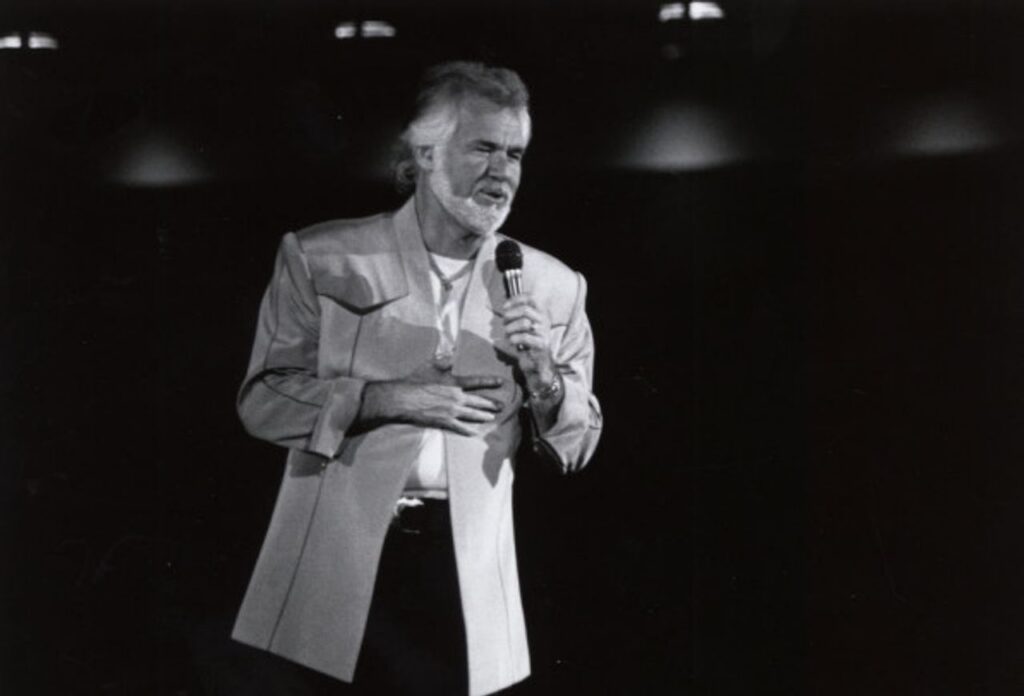
Archive concert footage from the era when Rogers was at the height of his touring fame.
Success gave Kenny Rogers a way to answer that sacrifice
By the late 1970s, Kenny Rogers had the means to do something few sons could do and fewer would think to do with such precision. He did not simply offer his mother a vacation or a few backstage passes. He designed a solution around the life she had actually lived and the comfort she deserved. He bought a custom-built luxury tour bus and hired a full-time professional driver solely for Lucille.
The gesture was lavish, but it was also deeply practical. Rogers understood both of his parents well enough to honor them in different ways. His father’s quiet, homebound habits were not mocked or erased. His mother’s long-delayed wish to travel was finally given room to unfold. And because he knew the realities of life on the road, he did not ask an aging Lucille to wedge herself onto crowded crew buses with band members and roadies. He gave her a rolling home of her own.
A private coach, not a seat on the crew bus
That distinction is what makes the story so memorable. A tour bus can symbolize glamour from a distance, but in practice the road can be cramped, noisy, and punishing. Rogers’s answer was to outfit a private motor coach for his mother, creating a space that was less transport than refuge. With her own driver at the wheel, Lucille could travel in comfort, on her own terms, rather than as an afterthought folded into the machinery of a superstar’s tour.
The arrangement also gave her something she had rarely enjoyed: companionship chosen for pleasure rather than necessity. She invited sisters and close friends along, turning the bus into a social space as well as a means of travel. Instead of moving only between obligations, she was finally crossing state lines toward cities she had once only heard about, following her son’s concerts across America and seeing the country in the process.
Interview clips and retrospectives that explore Rogers’s family background and his bond with his mother.
More than a gift, a reversal of the family story
What Kenny Rogers gave his mother was not just luxury. It was belated freedom. For decades, Lucille had been the engine of the family, the one whose labor kept everyone else in motion while she remained fixed in place. The bus reversed that logic. Now she was the one being carried, cared for, and invited to look outward. The woman who had spent years making life manageable for others was finally allowed to enjoy a life enlarged by possibility.
May you like


That is why the story endures. It compresses a larger American narrative into one vivid image: a son who rose from hardship, a mother who sacrificed without spectacle, and a success meaningful enough to be shared in a form she could actually use. Not jewelry, not a token, not a one-night celebration—but miles of road, a comfortable seat, familiar company, and the chance to see what had waited beyond the edge of duty for so long.

Quick Facts
Image credits: Philpottm / Wikimedia Commons / CC BY-SA 3.0; User kw111786 on Flickr (Original version) User UCinternational (Crop) / Wikimedia Commons / CC BY-SA 2.0; University of Houston Digital Library / Wikimedia Commons / CC BY-SA 2.0.